
CC BY-NC-SA 2.0 by Kevin Lim
Why?
The main motivation behind that is that is that I am very tired of the WordPress editor. I am a programmer and spend my days using the same editor1, which means that I have gotten rather efficient using it, or, at least, that’s the way of writing text that is the most comfortable to me.
In a stock WordPress installation, all you could do to edit your blog post in your own editor is to edit it in HTML and then cut and paste your result in the editor and publish. HTML. Eeek! I don’t want to be editing a tag soup, I want to focus on the content. There are better languages than HTML for that, such as reStructuredText or MarkDown. I did try WordPreSt a while ago but wasn’t satisfied with the work flow it provided, and if I remember correctly, I ended up having to correct things manually.
So, reading up a bit on the internets on what’s available, I got seduced by the concept of jekyll and its principle of offline generation of static pages, and the default workflow is very similar to the one I am used to when doing software development. Also, it seems to be actively maintained and used in GitHub Pages, which gives me a feeling that it’s here to stay. The only drawback that I see to it is that commenting cannot be handled by strictly static web pages. Most people using jekyll for blogging seem to resort to using external commenting services, such as Disqus and friends or even facebook, but I’d rather not depend on an external service for that. I’ve found a solution to that that seems decent to me, and I explain this in a later section.
Jekyll in itself is not a blogging system out of the box, but a good tool to make one. Since I didn’t feel like reinventing the wheel, I am using Jekyll-Bootstrap as a base for my blog.
Conversion of posts
I’d rather leave my old articles online, while still not have to manage a WordPress installation, so I definitely want to migrate my old articles to the new system. Luckily, jekyll comes out of the box with migration tools to make your life easy. I’ve used the tool that gets the content from a Wordpress export file and it went (mostly) like a breeze, as far as I could check. I only had to modify a bit the image caption code in one article. I still have some image files that aren’t where they should be in old posts, but that was already the case with WordPress. I will need to fix these articles at some point.
Static comments
The issue that I had left to deal with is to be able to have comments, and to import the comments I had in WordPress. I chose to use Jekyll::StaticComments (code here for that purpose. It is a plugin for Jekyll that takes comments in YAML files and renders them at the end of a post. That still left me with two problems: how do I migrate old comments from WordPress, and how do I let people add new comments?
Comment Migration
I’ve written a quick and dirty script with BeautifulSoup that gets the comment from a WordPress export file and generates a suitable tree of YAML files for use by Jekyll::StaticComments. I’ve put it online and called it wp2jekyll-comments.
Adding new comments
Jekyll:StaticComments comes with a PHP script that allows one to submit comments. Since I’m an awful geek, I don’t like much the idea of having to use PHP here, so I made my own version of it in Python. I’ve published it as jekyll-comments.
]]>I would like to explain a bit the stuff I've been working on recently at Igalia. It is about playing with GStreamer and a sandboxing system to try and make the playback of untrusted media more secure. Hopefully writing this will be an occasion for me to get more distance and understand things better, and for others to give me feedback and ideas. Particularly, even though that is for me a field of interest, I do not claim to have any real expertise in security, therefore comments by people who know better would be gladly welcome.
This story started when I decided to have a look at chromium and its internals. It turns out that one very specific aspect of this application is its sandboxing system. In a nutshell, a sandbox is a virtual container in which untrusted programs can be safely run. In the real world, sandboxes are rarely perfect, but they are a significant security improvement over not using one. Chromium uses a sandbox to run its rendering engine (WebKit), which is basically the part that transforms the code of a web page into the graphical representation of it that you see on your screen. The rationale for running WebKit in a sandbox is not that it is untrusted code in itself, but rather that it is a big and complex project that is bound to have bugs, like all big and complex projects. On top of that, the input given to it is quite often data from untrusted sources, which could potentially be forged so that it exploits security bugs to do bad things to your computer and your beloved files. Now, with WebKit running in a sandbox, if a web page has been forged by an attacker to exploit a vulnerability in WebKit, the attacker will only have access to the sandbox environment, which means that it won't be able to do things like access the data on your computer, install software or connect to remote hosts.
As you might know, I like to play with multimedia things, and have hacked quite a bit on or around GStreamer. Therefore, I quite automatically thought of something else that might be worth running in a sandbox: demuxers and decoders. They are relatively big and complex pieces of software to which we regularly pass a whole bunch of untrusted data, would it be in a web context or a more traditional desktop or mobile context.
Fortunately, Julien Tinnes, a developer of the chromium sandbox for GNU/Linux made a stand alone version of it called setuid-sandbox, which can be used by other projects to easily sandbox any process.
Architecture
The way setuid-sandbox works is rather straightforward: there is a sandboxme command that needs to be installed setuid root. You run sandboxme my_command and then from inside my_command, you first set up the file descriptors that you will need (being careful not to put there anything that could allow to escape the sandbox, more on that later), and then you call the provided chrootme() function, which will tell the sandboxme process to restrict the privileges that my_command has (e.g. it can still read and write on the fds that it has open, but it cannot open new ones).
Here is how I organised my integration of setuid-sandbox into GStreamer. What I want to do for now is to put what I think are the "most dangerous" parts (demuxing and decoding) in the sandbox, while letting the other components (mainly source and sinks) outside of the sandbox (for now at least). I decided to create a small program (called gst-decoder) that receives the original muxed and encoded video stream and outputs the decoded video and audio buffers. gst-decoder needs 3 channels of communication with the "controlling" process outside the sandbox (which is called the broker):
- one to pass the original stream from the source element in the broker to gst-decoder
- one to pass the video buffers from gst-decoder to the video sink element in the broker
- one to pass the audio buffers from gst-decoder to the audio sink element in the broker
In the future, more channels for subtitle support or other features could be desirable.
Since I am lazy, I wanted to use off the shelf GStreamer elements to handle these communication channels. For the cases explained above, that would be:
- the fdsink element on the broker side, and the fdsrc element in the sandbox
- shmsink (in gst-decoder) and shmsrc (in the broker)
- same elements as above
Since I expect other people to be equally lazy^W^W^Wwant their life to be made easier, my goal is to try and have this reasonably integrated in GStreamer, and easy to integrate in applications. For that, my best idea so far was to make a sandboxedecodebin element that, from the outside, works like decodebin or decodebin2, at least for simple cases: it has a sink pad that can take any format you would throw at decodebin, and it has an audio and a video source pads that output the decoded result. In the future, it might or might not be a good idea to try to integrate the "sandboxed" functionality in decodebin directly.
I implemented sandboxeddecodebin as a subclass of GstBin, and it has the following flow inside it:
fdsink -> [gst-decoder] | -> shmsrc (video) -> gdpdepay
                        | -> shmsrc (audio) -> gdpdepay
Note that gst-decoder is an external (sandboxed) process, and not a GStreamer element like the other entities of this data flow graph. The sink pad of fdsink and the source pads of the two gdpdepay elements are exported by sandboxeddecodebin through ghost pads, which provides a decodebin-like interface.
The gst-decoder program basically runs a pipeline that looks like that:
fdsrc ! decodebin2 name=decoder
decoder. ! video/x-raw-yuv;video/x-raw-rgb ! gdppay ! shmsink (video)
decoder. ! audio/x-raw-int;audio/x-raw-float ! gdppay ! shmsink (audio)
and it also makes sure to get the privilege dropped at the right time, which is discussed below.
When to drop privileges?
The ordering of operations needs to be thought carefully to combine GStreamer, and these elements in particular, with setuid-sandbox. Each of them brings its own set of conditions.
For setuid-sandbox, inside the sandbox (in gst-decoder):
- before we call chrootme(): we can open new fds and do a lot of nice initialisation, and we don't want to parse any untrusted data
- after we call chrootme(): we can't open new fds any more, or do similar initialisation tasks, but we can work on the data we received.
GStreamer has several states in which an element can be, with some rules on what should be done in which state. From the design documentation, the states are defined as follow:
- NULL: This is the initial state of an element.
- READY: The element should be prepared to go to PAUSED.
- PAUSED: The element should be ready to accept and process data. Sink elements however only accept one buffer and then block.
- PLAYING: The same as PAUSED except for live sources and sinks. Sinks accept and rendering data. Live sources produce data.
In particular, the elements that interest us here behave in the following way:
- shmsink is responsible for the creation and destruction of the shared memory object and the associated control socket and creates them when going from NULL to READY and destroys them when going from READY to NULL. Since shmsink is used from inside the sandbox, this means that the state change NULL to READY needs to happen before chrootme(). This also means that it won't be able to clean up properly the shared memory object and the control socket.
- fdsrc doesn't create nor destroy the fd it uses, so that can be done separately. Moreover, in the case of stdin, we leave that responsibility to the system.
And quite obviously, we want gst-decoder to handle buffers only after it has called chrootme(), so that it is ready to run potentially unsafe operations.
This is relatively easy: all we have to do is, in gst-decoder, to call chrootme() once we are in the READY state and before going to PAUSED.
Another issue with the privilege drop is that we use decodebin2 (things would be the same with decodebin), and it only loads the plugins it needs once it knows what kind of data it will have to decode. That is, it needs to load plugins after it has started to analyse potentially unsafe data. My solution to that is to preload all the installed plugins when gst-decoder starts, so that decodebin2 doesn't need any privilege to have access to the plugins it wants (they are already in memory).
This is obviously suboptimal in memory consumption. I can think of two ways to improve that:
- use a white/black list of plugins to avoid loading plugins we are not likely to need (there are many things we're pretty sure not to need in gst-decoder, such as all sources and sinks or gnonlin)
- use a separate typefinding sandboxed process that will determine what plugins are needed, then have gst-decoder take as argument the plugins that it needs to load before dropping privileges
Synchronising broker and sandbox
Another synchronisation issue is that the broker has to wait for the sandboxed process to be ready before interacting with it. As seen before, we have 3 channels through which they interact, and they are of two different types:
- the pipe to which the broker writes, which points to stdin in the sandboxed process
- the shared memory areas, and their associated control sockets created by the two shmsink
The first one is easy to synchronise: as long as the sandboxed process is not ready, it won't read on the pipe, and fdsink on the broker will just wait until it can write.
The second one is more complex: the shared memory areas are announced over the control socket when they are ready, so this part gets done correctly for free by shmsrc. But the control sockets need to exist when shmsrc tries to connect to them (this happens when going from READY to PAUSED). For now, my workaround is to sleep() for 2 seconds when sandboxeddecodebin goes from NULL to READY, after launching the subprocess. With this, the control sockets are very likely to be created when shmsrc goes from READY to PAUSED.
This is obviously very hackish , and I think I would prefer to use GFileMonitors to check when the sockets are created. Also, I don't know if it's better to do that in sandboxeddecodebin (blocking the switch to READY, but using that file monitoring instead of a sleep(), or going to READY asynchronously if that's possible?) or in shmsrc (in which case I think it should be optional and probably make shmsrc go to PAUSED asynchronously).
Making Preroll work
On the broker side, we have another tricky situation. We typically run a pipeline that contains all of this (the parts between angle brackets are outside of sandboxeddecodebin and given as examples):
<filesrc> ! fdsink (passes data to gst-decoder)
shmsrc (gets data from gst-decoder) ! gdpdepay ! <autoaudiosink>
shmsrc (gets data from gst-decoder) ! gdpdepay ! <autovideosink>
This pipeline is atypical in that it has a sink that is not really at the downstream end of it (fdsink, which sandboxeddecodebin uses to pass data to gst-decoder). Data would go through it, then through gst-decoder and its own pipeline, and then emerge back in the broker's pipeline in the shmsrc elements.
This is a problem at the preroll phase. Preroll is what usually happens when going to PAUSED: the sinks wait until they have a buffer to render before committing the state to PAUSED. The issue with our pipeline, is that the "real" sinks will only get the data they need to commit to the PAUSED state if fdsink lets the data through, but fdsink only passes data once it is in PLAYING state (apart maybe from one initial buffer). On top of that sandboxeddecodebin is a subclass of GstBin. By default, GstBin only changes to the next state (e.g. PLAYING) once all its elements have reached the previous one (e.g. PAUSED). This gives us a nice deadlock: the final (downstream) sinks are waiting for data to come to them to commit their change to PAUSED, GstBin is waiting for all its elements (including final sinks) to finish their transition to PAUSED before asking them to go to PLAYING, and fdsink is waiting to be asked to switch to PLAYING before it lets the data through (that the final sinks are waiting on). My workaround to solve this deadlock is to manually request fdsink to go to PLAYING when sandboxeddecodebin is switching to PAUSED. That way, fdsink is "one state ahead" of the rest, and lets the data go through. I haven't decided yet if it's a very ugly way of solving that issue or if it's an awesome clever hack. If you have an idea of a cleaner solution, feel free to suggest it in the comments!
Analysis of open file descriptors
Once the privileges have been dropped, the sandboxed process is very limited in what it can do, but it still can use all the fds that it has open, which might be a way for it to escape the limitations we want to put on it. For instance, imagine that the sandboxed process has an open fd on the device that contains your home directory (say, /dev/sda). By reading it, it can access all your data, even though the sandbox is designed not to let it open more files.
This precise example is very unlikely to happen in our case, but some less obvious fds could lead to ways to escape the sandbox. That is why I think it is necessary to analyse the file descriptors that are open in the sandboxed process and to try to understand the risks they bring.
I took a "snapshot" of the open fds of gst-decoder while it was decoding a video, and here is what it looks like:
guijemont@thirtytwo:~$ ls -lv /proc/5860/fd
total 0
lr-x------ 1 guijemont guijemont 64 2012-04-18 18:17 0 -> pipe:[8348338]
lrwx------ 1 guijemont guijemont 64 2012-04-18 18:17 1 -> /dev/pts/5
lrwx------ 1 guijemont guijemont 64 2012-04-18 18:17 2 -> /dev/pts/5
lrwx------ 1 guijemont guijemont 64 2012-04-18 18:17 3 -> anon_inode:[eventfd]
lr-x------ 1 guijemont guijemont 64 2012-04-18 18:17 4 -> pipe:[8348342]
l-wx------ 1 guijemont guijemont 64 2012-04-18 18:17 5 -> pipe:[8348342]
lrwx------ 1 guijemont guijemont 64 2012-04-18 18:17 6 -> socket:[8358884]
lr-x------ 1 guijemont guijemont 64 2012-04-18 18:17 7 -> pipe:[8359036]
l-wx------ 1 guijemont guijemont 64 2012-04-18 18:17 8 -> pipe:[8359036]
lrwx------ 1 guijemont guijemont 64 2012-04-18 18:17 9 -> anon_inode:[timerfd]
lrwx------ 1 guijemont guijemont 64 2012-04-18 18:17 10 -> /run/shm/shmpipe. 5860.    0
lrwx------ 1 guijemont guijemont 64 2012-04-18 18:17 11 -> socket:[8358886]
lrwx------ 1 guijemont guijemont 64 2012-04-18 18:17 12 -> socket:[8358887]
lrwx------ 1 guijemont guijemont 64 2012-04-18 18:17 13 -> socket:[8358888]
lrwx------ 1 guijemont guijemont 64 2012-04-18 18:17 14 -> /run/shm/shmpipe. 5860.    1
lrwx------ 1 guijemont guijemont 64 2012-04-18 18:17 15 -> socket:[8358890]
lrwx------ 1 guijemont guijemont 64 2012-04-18 18:17 16 -> socket:[8358891]
lrwx------ 1 guijemont guijemont 64 2012-04-18 18:17 17 -> socket:[8358892]
lrwx------ 1 guijemont guijemont 64 2012-04-18 18:17 18 -> socket:[8358893]
lrwx------ 1 guijemont guijemont 64 2012-04-18 18:17 19 -> socket:[8358894]
lrwx------ 1 guijemont guijemont 64 2012-04-18 18:17 20 -> socket:[8358895]
lrwx------ 1 guijemont guijemont 64 2012-04-18 18:17 21 -> socket:[8348346]
lrwx------ 1 guijemont guijemont 64 2012-04-18 18:17 22 -> socket:[8348347]
I used the "usual suspects" (strace and gdb) to look further into this and understand where each fd comes from, and try to get an idea of how necessary it is and of how much of a risk it brings.
- O: that is stdin, and it is the pipe I create when starting sandboxme gst-decoder. Also, it is read only. I don't think an attacker could do much with this, and we need it anyway.
- 1 and 2: stdout and stderr, plugged to the pseudo tty where my test gst-launch command was running. This is clearly not necessary, and could be exploited for privilege escalation if there's a bad bug somewhere in devpts. I modified the code to make stdout and stderr point to /dev/null instead when gst-decoder is launched. There is an environment variable that can prevent that from happening when one wants to see the debug messages that are output by gst-decoder.
- 3: This is an event fd used by the GMainContext. I suspect that at least a few of the components we run to decode our stuff needs a GMainLoop, and therefore a GMainContext. And I don't think this is very dangerous, though I don't know much about the complexity and safety of the event system.
- 4 and 5: this is a pipe used by the GLib unix signal code. Both ends of the pipe are inside the sandbox, so I don't think this would be much of a problem.
- 6 and 21: shm area control socket for audio. There is one fd created by socket() that is bound to the right temporary file, then another fd is created by accept() when the broker connects. We definitely need that if we want to use shm, which I think we do for performance reasons (I did not run benchmarks though).
- 7 and 8: pipe open by some code in /usr/lib/frei0r-1/facedetect.so when it is g_module_open()'ed. I don't think we need that at all, and it might be a good motivation to try and not load all plugins. A limited risk though, since both ends of the pipe are inside the sandbox.
- 9: a timer fd opened in the same conditions as the pipe of fds 7 and 8 (by frei0r's facedetect). This one definitely looks like an unnecessary risk, though I don't know how much of a risk it actually is.
- 10 and 14: these are the shared memory areas (one for audio, one for video), so I think we definitely want them. The alternative would be to use regular sockets instead to pass the buffers, but I fear it might cost us much in performances for little added security, though this issue could deserve more investigation.
- 11, 12, 15, 16, 17, 18, 19 and 20: these 8 fds are actually 4 socket pairs,
with each time both ends inside the sandbox. They are all created by
gst_poll_new(), by the following pieces of code:
- shmsink in gst_shm_sink_start(). It does that twice: once for audio, once for video.
- fdsrc in gst_fd_src_start().
- the system clock (in gst_system_clock_init(), via gst_poll_new_timer()).
- 13 and 22: shm area control socket for video. There is one fd created by socket() that is bound to the right temporary file, then another fd is created by accept() when the broker connects. We definitely need that if we want to use shm, which I think we do for performance reasons (I did not run benchmarks though).
Play with it!
You can check out the code from its github repository, instructions are available here.
I am now back from Prague where I gave a talk on image stabilisation (and my holiday pictures). Hopefully a video of the talk will soon be online. In the meantime, I would like to explain a bit my efforts in written form, with some details slightly updated from the talk (the code progressed a bit since then).
UPDATE: The talk is now online.
I got interested in the issues of image stabilisation through a helium balloon photography project in which I participated. I want to make a nice time lapse video from the pictures I have taken, but they were taken from a camera that was moving, which would make the result very shaky without some kind of postprocessing.
Thankfully, I work at Igalia, which means that on top of my personal time, I could spend on this project some company time (what we call internally our hackfest time, of up to 5 hours per week).
Original problem statement
I have around 4h30 of pictures taken from a balloon 100 metres high. The pictures were taken at a rate of one per minute, which makes around 270 pictures. I want to make a nice time lapse out of it. Simply using the frames as is to build a video does not work well. Partly because I would probably be legally required to include a warning to epileptic people at the beginning of the video, but mostly because people actually watching it would wish they were epileptic to have a good excuse not to watch it.
This is due to the huge differences occurring between two consecutive frames.
Here is an example of two consecutive frames in that series:


As you can see, from one frame to the next, a lot of pixels would change. And that does not look pretty. It is also pretty obvious that they are both pictures of the same thing, and could be made to be pretty similar, mainly by rotating one of them, and maybe reprojecting it a bit so that things align properly even though the point of view changed a bit from one frame to the next.
Standing on the shoulders of giants
There was no question in my mind that I wanted to use GStreamer for the task, by writing an element or set of elements to do the stabilisation. The two big advantages of this approach are:
- I can benefit from all the other elements of GStreamer, and I can easily do things like decode my pictures, turn them in a video, stabilise it and encode it in a format of my choice, all in one command.
- Others could easily reuse my work, potentially in ways I could not think of. One idea would be to integrate that in PiTiVi in the future.
Then, after some research, I realised that OpenCV provides a lot of the tools needed for the task as well.
Since I am still in a prototyping/research stage, and I hate to write loads of boilerplate, I am using python for that project, though a later rewrite in C or C++ is not impossible.
First things first
I will not present things exactly in the order I researched them, but rather in the order I should have researched them: starting with a simpler problem, then getting into the complications of my balloon problem.
The simpler problem at hand is presented to you by Joe the Hippo:
Joe the shaky hippo (video)
As you can see, Joe almost looks like he's on a boat. He isn't, but the cameraman is, and the video was taken with a lot of zoom. The movement in that video stream has a particularity that can make things simpler: the position of a feature on the screen does not change much from one frame to the next, because a very short amount of time happens between them. We will see that some potentially very useful algorithms take advantage of that particularity.
The steps of image stabilisation
As I see it for the moment, there are two basic steps in image stabilisation:
- Find the optical flow (i.e. the movement) between two frames
- Apply a transformation that reverts that movement, on a global (frame) scale
Step 2. is made rather easy by OpenCV with the findHomography() and warpPerspective() functions, so we won't talk much about it here.
Optical flow
For all that matters in this study, we can say that for each frame the optical flow is represented by two lists of point coordinates origins and destinations, such that the feature at the coordinate origins[i] in the previous frame is at the coordinate destinations[i] in the current frame.
Optical flow algorithms can be separated in two classes, depending on whether they provide the flow for all pixels (Dense optical flow algorithms) or only for selected pixels (Sparse optical flow algorithms). Both classes can theoretically provide us with the right data (origins and destinations point lists) to successfully compute the opposite transformation we want to apply using findHomography().
I tried one algorithm of each class, choosing the ones that seemed popular to me after reading a bit of [Bradski2008]. Here is what I managed to do with them.
Dense optical flow
I tried to use OpenCV's implementation of the Horn-Schunck algorithm [Horn81]. I don't know if I used it incorrectly, or if the algorithm simply cannot be applied to that situation, but this is all I could do to Joe with that:
Now Joe is shaky and flickeryAs you can see, this basically added flickering. Since that, I did not find time to improve this case before I realised that this algorithm is considered as obsolete in OpenCV, and the new python bindings do not include it.
Note that this does not mean that dense optical flow sucks: David Jordan, a Google Summer of Code student, does awesome things with a dense algorithm by Proesmans et al. [Proesmans94].
Sparse optical flow
I played with the Lucas-Kanade algorithm [Lucas81], with the implementation provided by OpenCV. Once I managed to find a good set of parameters (which are now the default in the opticalflowfinder element), I got pretty good results:
Joe enjoys the stability of the river bank, undisturbed by the movements of the water (video)And it is quite fast too. On my laptop (with an i5 processor), I can stabilise Joe the hippo in real time [1] (it is only a 640x480 video, though).
| [1] | For those who attended my talk at the Gstreamer Conference 2011: yes, now it is proper real time, I optimised the code a bit. |
The balloon problem
As we seen in the previous section, for a shaky hippo video, [Horn81] isn't any help, but [Lucas81] is pretty efficient. But can they be of any use for my balloon problem?
Unsuccessful results
I won't show any video here, because there is nothing much to see. Instead, an explanation in pictures that show how the algorithms rate for the balloon time lapse.
This is what Horn-Schunck can do:

The picture shows two consecutive frames in the time lapse (the older is on the left). Each of the coloured lines goes from a point on the first image to the corresponding point on the second one, according to the algorithm (click on the image to see a larger version where the lines are more visible). Since Horn-Schunck is a dense algorithm, the coloured lines are only displayed for a random subset of points to avoid clutter.
Obviously, these lines show that the algorithm is completely wrong, and could not follow the big rotation happening between the two frames.
Does Lucas-Kanade rate better? Let's see:

This is the same kind of visualisation, except that there is no need to chose a subset, since the algorithm already does that.
As for the result, it might be slightly less wrong than Horn-Schunck, but Lucas-Kanade does not seem to be of any help to us either.
The issue here, as said earlier, is that these two algorithms, like most optical flow algorithms, are making the assumption that a given feature will not move more than a few pixels from one frame to the next (for some value of "a few pixels"). This assumption is very clever for typical video streams taken at 25 or 30 frames per second. Unfortunately, it is obviously wrong in the case of our stream, where the camera has the time to move a lot between two frames (which are captured one minute apart).
Is all hope lost? Of course not!
Feature recognition
I found salvation in feature recognition. OpenCV provides a lot of feature recognition algorithms. I have tried only one of them so far, but I hope to find the time to compare it with others in the future.
The one I tried is SURF (for "Speeded Up Robust Features", [Bay06]). It finds "interesting" features in an image and descriptors associated with them. The descriptors it provides are invariant to rotation and scaling, which means that it is in theory possible to find the same descriptors from frame to frame.
To be able to efficiently compare the sets of frame descriptors I get for two consecutive frames, I use FLANN, which is well integrated in OpenCV.
Here is a visualisation of how this method performs:

As you can see, this is obviously much better! There might be a few outliers, but OpenCV's findHomography() can handle them perfectly, and here's a proof video (I am not including it in the article since it is quite high resolution).
Obviously, the result is not perfect yet (especially in the end), but it is quite promising, and I hope to be able to fix the remaining glitches sooner than later.
Show me the code!
The code as well as a quick introduction on how to use it is available on github. Bugs and patches should be posted here.
| [Bradski2008] | G. Bradski and A. Kaehler , "Learning OpenCV", ISBN 978-0-596-51613-0, 2008. |
| [Horn81] | B. K. P. Horn and B. G. Schunck, “Determining optical flow,” Artificial Intelligence 17 (1981): 185–203, 1981. PDF |
| [Proesmans94] | M. Proesmans, L. Van Gool, E. Pauwels, A. Oosterlinck, "Determination of optical flow and its discontinuities using non-linear diffusion", J.-O. Eklundh (Ed.), Computer vision -- ECCV '94, Lecture Notes in Comp. Science, Vol. 801, Springer, Berlin, 295–2304, 1994. PDF |
| [Lucas81] | B. Lucas and T. Kanade, "An Iterative Image Registration Technique with an Application to Stereo Vision", Proc. of 7th International Joint Conference on Artificial Intelligence (IJCAI), 674–279 PDF |
| [Bay06] | H. Bay, T. Tuytelaars and L. Van Gool, “SURF: Speeded Up Robust Features”, 9th European Conference on Computer Vision, 2006. PDF |

Karlův most (Charles bridge)
 I am going there sponsored by the awesome company I work for, Igalia. Many other igalians will be there too.
Grilo will be well represented, with a short talk by Philippe on his integration work of Grilo with the Gnome Shell, and a hacking session with Juan and myself.
I will stay in Berlin until the 15th of August, to attend the GObject Introspection hackfest, where I will also be sponsored by Igalia. I should admit I don't know much about the internals of GI yet, but I am excited to "learn by hacking" in the company of great hackers!
Then I will continue my Eurotrip, but that is another story.
]]>
I am going there sponsored by the awesome company I work for, Igalia. Many other igalians will be there too.
Grilo will be well represented, with a short talk by Philippe on his integration work of Grilo with the Gnome Shell, and a hacking session with Juan and myself.
I will stay in Berlin until the 15th of August, to attend the GObject Introspection hackfest, where I will also be sponsored by Igalia. I should admit I don't know much about the internals of GI yet, but I am excited to "learn by hacking" in the company of great hackers!
Then I will continue my Eurotrip, but that is another story.
]]> (before)
 (after: notice the "+" buttons on the left)
I still have some work to do on that to make it as great as I'd like, which means it might not be upstreamed before a small while. Some issues to fix:
(after: notice the "+" buttons on the left)
I still have some work to do on that to make it as great as I'd like, which means it might not be upstreamed before a small while. Some issues to fix:
- I have discussed with the great folks on #bzr, namely GaryvdM, jelmer and vila, and I think we all agree that bzr viz is slow, whereas bzr qlog feels much faster, and the good thing is that the graph generation stuff in bzr qlog is quite well separated from the UI stuff, so it should be pretty easy to use it in bzr-gtk. The medium-term goal would be to put that generation code in bzrlib, and have both qbzr and bzr-gtk use it.
- I don't like much the way TreeView displays the trees. I'd much prefer if the "+/-" signs were in the revision node thingies, like it is in qlog, and if the revision numbers were not moved to the right when in subtrees (if you're at level 2, you can't see the revision number in full any more)
- Compile GStreamer (and its dependencies) using the NDK
- Find a way to alleviate the limitations of android's dynamic linker on at least some versions of android (I've only tested with 1.5 so far, which is what I have on my phone), and compile, as properly as can be, all the gstreamer plugins that might be useful
- Write/port a binding that allows to use GStreamer from the java code of an android application.
- Conquer the world!
- compiled GLib and GStreamer with the NDK (see there: glib, gstreamer), branching from the work previously done for the "platform" port
- wrote a minimal binding using JNI (which seems to be the recommended way on android); for now, as it is generated by hand and I am lazy, it only binds gst_init() and gst_version_string()
- integrated all that in a modified version of the "Hello JNI" NDK example, that displays the result of gst_version_string():
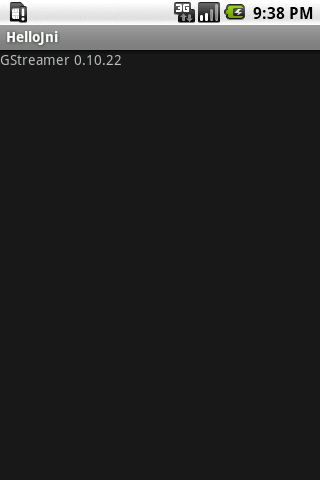
So, hopefully, I will soon post updates on the advancement of these things, posting this might create some peer pressure to motivate me ;).
If you have any ideas/advice/comments/questions about all that, please feel free to leave a comment or contact me ]]>
Today, I have resolved point 3 (or at least made a big leap in that direction).
That old CSS, first with the Union Jack, then with a mix of it with la Senyera and the awful pink background amused me at the beginning, but I think I got tired of it. So, here's the new style, aimed at simplicity and readability, hope you like it! Of course, (constructive) comments are welcome!
For the nostalgic/masochist among you who know how to use their web browser, the old stylesheet is still available under the name "old ugly style". ]]>
 So, lately, the big news is, at work, we've just released Moovida 1.0. Moovida is what used to be called Elisa, with more cool in it :). We've totally reworked the interface, and I must say it now rocks! Kuddos to everyone involved, we're starting to have something quite cool. Just check it out, tell me what you think and report bugs if you find any.
Also, for those who don't know, I'm now on identi.ca and twitter, and I've been updating quite a bit today about how the release was advancing, with some pictures posted here.
]]>
So, lately, the big news is, at work, we've just released Moovida 1.0. Moovida is what used to be called Elisa, with more cool in it :). We've totally reworked the interface, and I must say it now rocks! Kuddos to everyone involved, we're starting to have something quite cool. Just check it out, tell me what you think and report bugs if you find any.
Also, for those who don't know, I'm now on identi.ca and twitter, and I've been updating quite a bit today about how the release was advancing, with some pictures posted here.
]]>Alors peux tu expliquer à l'inculte en info que je suis ce qu'est un hoax ? Ça doit être un virus quelconque non ?Je me suis alors senti obligé d'écrire un roman, grand défenseur que je suis de la veuve, l'orphelin, la cousine perdue dans son outlook et ma boite e-mail qui n'arrête pas d'exploser, j'ai commencé à écrire, et j'en ai fait un roman, que je vous copie ici. Chères cousines, désolé pour le temps de réponse, je suis très demandé ;). Alors hoax, c'est juste une traduction de "canular" en bon français. Et il y en a plein qui circulent par email. C'est pas vraiment un virus, mais ça peut s'y apparenter dans la mesure où:
- ça se multiplie (eh oui, en faisant suivre cet e-mail, tu l'as multiplié)
- c'est nuisible (j'ai déjà trop d'e-mails qui arrivent dans ma boite, et le pauvre gars à qui l'e-mail invite à envoyer la pétition a probablement du fermer sa boite).
C:\Program Files\bazaar\plugins. I don't remember if I managed to make it work or not (did I say it was a while ago?), but I eventually uninstalled it, as well as any dependency that I might have installed for the occasion. Ever since that day, whenever I ran a bzr command, I had the following output preceding the expected output of said command:
No Python bindings for Subversion installed. See the bzr-svn README for details.
Unable to load plugin u'bzr_svn' from u'C:/Program Files/Bazaar/plugins'
Even though I don't have any bzr_svn plugin in that directory! Yes, I tripled checked!
This had been driving me crazy for months now, and today, by pure chance, I stepped across a directory called C:\Users\guijemont\AppData\Local\VirtualStore that contained a Program Files directory. Having a look at it, I discovered, after months of struggling with that awful and undeserved error message that there was a:
C:\Users\guijemont\AppData\Local\VirtualStore\Program Files\bazaar\plugins\bzr_svn
Yeah, really. And it was full of .pyc files. What happened is that, whenever a user program tries to write somewhere where it shouldn't (such as Program Files), UAC gives it the impression that it succeeded, and write the stuff in that VirtualStore instead of the real place. That is a convenience that might save the day to some programs that don't behave and write in places where they shouldn't.
Enters python. Python writes .pyc files, which are slightly compressed versions of the original .py files (and therefore faster to load). It writes them in the directory where the .py file resides (I guess it makes a lot of things easier to manage).
Then you mix both. Install bzr-svn, use it as a normal user, remove it: it's not removed! Because the .pyc files are still there, hidden in VirtualStore.
And they say that OS is user-friendly? As I user, I find it friendly that a directory is deleted when I delete it...
]]>
]]>
 J'ai hâte de pouvoir faire des jeux marrants avec mes rides :)
]]>
J'ai hâte de pouvoir faire des jeux marrants avec mes rides :)
]]>
Plus de preuves ici, vu que beaucoup de gens m'ont mis la pression pour que je les mette en ligne :).
]]>
let &errorformat .= ',\%+G-version-info\ %*\\d:'
This tells vim that anything with "-version-info [number]:" is a general message, and not an error or warning. To ensure this is used, I have the following line in my ~/.vimrc:
au FileType c compiler gcc
Note that you could also achieve a similar result by setting the g:compiler_gcc_ignore_unmatched_lines variable, but then you might miss real errors that don't point to a specific file (like some linking errors) as I understand it.
- Rage Against The Machine
- Metallica
- Iggy & the Stooges
- Machine Head
- Cavalera Conspiracy
- Serj Tankian
- Eths
- Queends of the Stone Age
- ETHS
That might also be an occasion to visit a bit Madrid, but I don't know if I will have much time for that :/.
]]>
Also, I have put stuff in place to ease the job, and to ease collaboration (yes YOU are invited to participate), more specifically the following:
I am quite happy with most of PafClock and PafAnimation. I think PafImplicitAnimator needs a bit more reflection, and I don't like that much the name of PafModifier. If you don't understand what all these objects are, please have a look at the wiki page, get the branch (bzr branch lp:paf) and have a look at misc/paf.xmi (UML file, readable at least with umbrello) and examples/poc.c (examples of how the library could be used). ]]>
To answer these questions, I have written some code, that would do as many g_object_set()/g_object_get() as you want, and measure how much CPU time it takes. The code is available as a bzr branch at http://emont.org/property-tests/, look in the gobject directory (I have also written a similar code in python, and in "simple C" with nested structures).
The result of this, on my laptop (a Pentium M 1.86 GHz) is the following:
$ ./gobject/test 1000000
n=1000000
stress_set(): 1.440000
stress_get(): 0.480000
stress_get_set(): 1.940000
$
Here I ask for a million of sets, then a million of gets, then a million of couples get,set (to increment my float property by 0.1 at each iteration).
So, we can say that on my machine, a g_object_set() takes about 1.5 µs. Now, if we want to animate simultaneously a hundred properties, meaning that we want to update them all at each frame, we will spend 150µs just for g_object_set().
Let's consider we have a 60 Hz screen, that means we have a total time of 16.667 ms, or 16,667 µs, and that in that case, we will spend about 1% of our time updating properties; I want to say that's something that can be afforded in most cases. On modern embedded device, I guess we can expect the CPU to be up to 5 times slower, so in this case, that would be more like 5% of our time spent on updating GObject properties. That might be more of an issue, especially since CPU usage means energy consumption.
A question that remains open is Could g_object_set() be more efficient?
To be frank, I don't really know, but I have made a similar test with python:
$ python python/test.py 1000000
n= 1000000
stress_set(): 0.29
stress_get(): 0.14
stress_get_set(): 0.34
$
I would tend to consider that the object system of python provides a similar set of functionality, but here, we're speaking of 0.3µs (about 5 times faster than GObject), so, yeah, I guess there is room for improvement in g_object_set(), but it is yet to be decided if it is worth it...
Yet, it is a certain thing that the price is cheap enough for animations on the desktop, and for that reason it makes sense to put GObject propertiy animation facilities in PAF, and to add GObject properties to Pigment or Clutter at some point, since it would tend to make the programming (and creation of language bindings) of these things much easier.
]]>
The issues
As I said earlier, we are thinking of what Pigment 0.5 should look like. First, here is a list of things that suck in pigment 0.3, and need (heavy) rearchitecturing to be fixed:- no real 3D support: we can't do rotations or efficiently apply a transformation on a group of drawables, we can't handle lighting, different cameras or camera movement.
- there is no support (at least not in C) to ease the application of a transformation to a given set of drawables. There is a basic "group" support in pigment-python, but it is slower than it should and limited.
- writing a rendering plug-in is too complicated. A lot of the stuff that is done in plug-ins could be factorised in the core. This is partly why we only have an OpenGL rendering plug-in in Pigment 0.3
- there is no programmatic way (there's only logging) to asynchronously retrieve errors, even though most pigment functions trigger asynchronous events.
- the animation system (which is done in python, but that is not an architectural issue, we could do it in C) is not synchronised with the rendering.
- it is impossible to build pigment without GStreamer because we use GstObjects everywhere.
The solution
The other day at lunch, a soon to be ex-colleague told us (as I remember it):Here, we don't want to precipitate things, so all of these solutions might not be in place in 0.5.0, though the whole project will be architectured with these in mind, so we can add them later in 0.5.x. Anyway, here is the list of solutions we've been thinking of:You can either be part of the solution, or you can be part of the precipitate.
- API separation: we will have two distinct APIs, though they will be mostly compatible:
- a 2D API that will be the only one available when using a 2D rendering plug-in (such as DirectFB or SDL) and will probably be quite similar to pigment 0.3.x
- and a 3D API that will allow to take full advantage of modern GPUs, using proper 3D rendering plug-ins (such as OpenGL, OpenGL ES, or maybe someday Direct3D, who knows?)
- Basic scene graph: be able to accumulate transformations, with each node rendered with the transformations and states set for itself and its parents.
- Revamping of the plug-in system, to minimise the amount of work needed to write a rendering plug-in.
- Have an asynchronous way to report errors. GStreamer seems to do that with a bus, that might be a good idea for us.
- Use PAF (an animation library) when it's here, integrate it so that it is synchronized with the rendering.
- Stop using GstObjects. We use them in 0.3.x for easy logging and for the floating references facilities they provide. I see three ways to do that:
- Implement our own PgmObjects providing the same functionalities.
- Use GstObjects when GStreamer is available, forget about logging when it isn't. That would only leave the floating reference stuff to reimplement.
- Fork the GstObject stuff out of GStreamer into a separate library.
Bonus track
These are non-architectural stuff that we'd like to implement at some point, some of them might even make their way into 0.3.x:- Support for compositing (masking, specific blending functions between drawables).
- Support for OpenGL ES, Loïc is actually already working on that for 0.3.
- Improvements in texts: right now, it is impossible to know how much space your text is going to take (or how much text you can fit in your drawable) or to scroll text; functionalities for this would be great.
- Big improvements in texts (3D plugins): instead of rendering text in CPU into a texture, we could render them as polygons, that would eliminate all the issues regarding "when should we regenerate the text texture?".
- Support for vectorial graphics rendering through cairo.
- Support for SVG (possibly through cairo as well).
- GStreamer source: we already have a sink, a "PgmViewportSource" could be something useful for many people.
- Support for 3D models.
- Many other countless details (see below).
Conclusion
Of course, these three lists may evolve a bit, but overall, that's what we plan for the 0.5.x series. Note that there's also a wiki page about this. Needless to say, pigment 0.5 is gonna be *awesome* and allow applications to go a big step forward in UI experience(*). That should happen quite soon too: our ideal goal is to have something working for GUADEC 2008, and in all case, we should have a quite complete 0.5 by the end of the year.(*) Read: applications using pigment are gonna kick asses. ]]>
Interactive Animation
This demonstration shows the ability of pigment to load images and place them in a 3D space. It shows a bit of what the animation system can do as well. This is done in about 150 lines of python code.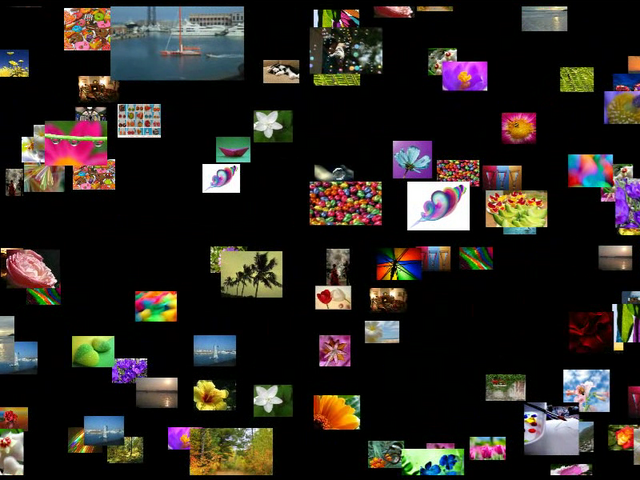 You can find the source code for that in Kaleo's bzr branch: http://boucault.iiens.net/pigment_experiments/. It's the same program (volume.py) than the last screencast in Kaleo's blog post.
Effects
This one shows the ability of pigment to integrate with a graphical toolkit (here Gtk+). It also shows various effects that pigment can apply on images or videos (a 1080p HD video in this case) without any CPU cost, everything being done in the GPU. This is done in about 350 lines of python code, including 135 lines to construct the Gtk+ interface. Sorry, I didn't have a decent webcam at hand, so I couldn't reproduce what Loic did at his talk.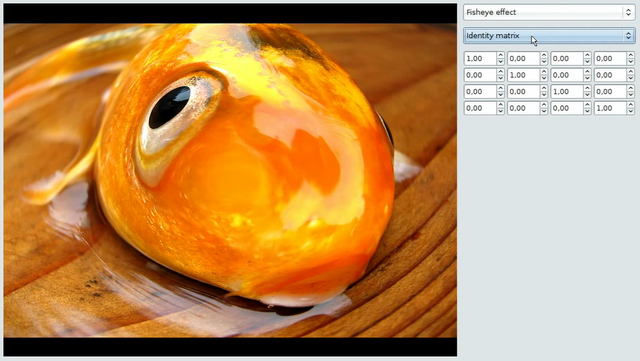 This is done with a branch of pigment not merged with trunk yet, you can find it on a branch of our subversion repository:
https://code.fluendo.com/pigment/svn/branches/pigment-effects
The example screencasted here is colormatrix.py, in pigment-python/examples on the branch
]]>
This is done with a branch of pigment not merged with trunk yet, you can find it on a branch of our subversion repository:
https://code.fluendo.com/pigment/svn/branches/pigment-effects
The example screencasted here is colormatrix.py, in pigment-python/examples on the branch
]]>- a timeline, similar to what is implemented in QTimeline or GtkTimeline
- an animation object, that handles the evolution of the animated variables from an evolution function, that could be constructed using...
- an interpolator, that could interpolate in different modes (linear, bezier splines, cubic hermite splines, ...) between key values/times/speeds/accelerations.
- facilities for implicit animations on GObject properties. This would dramatically ease the creation of animations, especially in language bindings (I'm thinking at least of Python here).
- depend only on GLib.
- easily bindable.
- easy to use with any library (be it in C or in a language for which there is a binding for this library).
- easy to use with a C/GObject library (think of GTK+, Pigment or Clutter).
bzr branch http://emont.org/paf/
The only interesting stuff so far is paf.xmi and the stuff in examples/.
Here is what this could look like, in Python, for a GObject image that has a property 'x' defining it's horizontal position:
# Move @image's x position linearly to @dest. Implicit version.
def implicitly_move_image (image, dest):
    animator = paf.ImplicitAnimator(image)
    animator.x = dest
I have still many things to figure out and to improve, but that's already a start and I plan to actively work on this, since we badly need that for Pigment.
When I start to be happy with the API, I will write the documentation and some empty C/GObject code, so that the output of gtk-doc can be used as a basis for discussion.
Of course, anyone is welcome to participate in this effort, feel free to branch and to send me patch/address of other branches. This will be LGPLv2.1 or later, unless I find good reasons to publish it under LGPLv3.
Please contact me if you have any comments, ideas questions or patches on this blog, on freenode/#pigment or by email (guillaume at fluendo dot com).
]]>- The performances of the opengl rendering have been highly improved. In most cases, think of a framerate multiplied by 2 or 3. I now have Elisa running very smoothly at 1400x1050 on my ATI M300 with the free drivers.
- Better integration with the desktop: startup notification, drag and drop.
- The font height of a text is now proportional to a drawable and not to the whole canvas. This makes resizing behaviours much more consistent (as long as you don't change the height/width ratio of your drawable).
There are times when everything goes wrong, but these times make you appreciate things when they go back to normal.
At my flat, we had an issue with the shower until this week-end: the water didn't evacuate easily. That's a kind of situation that is annoying, but that generally takes some time to get fixed. It takes time, because you're always in a hurry when the problem happens (in the morning). Yet, courageous Kaleo decided to investigate the issue on Sunday. Only, neither he nor I are plumbers, and things only got worse: the evacuation thingy(1) under the shower was only attached by one screw. When unscrewing it to clean everything, the thingy(1) separated, and we couldn't put it back. The result of this operation is that we couldn't have a shower without forcing our neighbour downstairs to have one as well (and he may not have his shower under ours). So, since Sunday: no shower, we had to cope with the sink (it IS a pain to rinse your hair in the sink when you have long hair).
This situation was a bit of a pain, especially in the time when we were working hard for the next releases of Elisa and Pigment (they got out today). But this was still possible to handle for a limited amount of time. We warned the rental agency on Monday morning, so that they arrange for a plumber to come and fix that ASAP (in Spain, this means "in less than a month"). But with only this, [Karma|God|Murphy's law] wasn't finished with us.
This is what we realised later on Monday, when electricity went out in the flat. I think we were quite lucky to have previously bought a pack of 100 candles, that proved quite handy. Especially since that was again something we couldn't fix ourselves (yeah, we tried, no, we didn't make things worse this time). And, believe me, it IS even more a pain to wash your long hair in the sink when your only source of light is candles (at least psychologically).
I don't know if our rental agency is usually efficient (well, to Spanish standards at least) or if they had pity for us to be without a shower and in the dark, but an electrician came yesterday to fix the electricity (apparently temporarily, he'll have to come back), and a plumber could come today to fix the shower evacuation. I guess it wasn't practical for the plumber to come earlier, it would be a pain to fix that lightened by candles :).
Now that everything is back to normal, I feel quite good after having a shower, and, at least for tonight, I don't feel too bad about orange, even though they still haven't activated our ADSL line ordered on the 22nd of November (maybe more on that later)...
(1) sorry, my English plumbing vocabulary sucks, even though it's substantially better than my Spanish. ]]>
Gotta learn Spanish and Catalan... ]]>
MSNCensorship - Adium X - Trac ]]>
This all started on a Tuesday, when I got in the train where Karolína and Jan (great Czech friends studying in Hull) were already sleeping/seated. Shortly after, we were waiting at the airport. This time, not to greet new international students, like during the international welcome week last September, but to take a plane to Barcelona (you wouldn't have guessed).
Our plane landed there at sunset. That was quite early for Barcelona. At first I was afraid I would arrive at the hostel too late to check in, but when I asked to check in at about 11pm, I was told I was too early and had to wait :). I don't know how things are there in winter, but in mid June, Barcelona is a 24/7 city. Las Ramblas (main pedestrian street) is at 2am on a week day crowded like an equivalent street in France or England on a Saturday at 3pm.
We eventually could enjoy a (pricey) sangria on las Ramblas (piece of advice for people going to Barcelona: there are much cheaper sangrias than on las Ramblas). We here means the Czechs, Kaleo and I. It should be mentioned the reason we went to Barcelona was to visit Kaleo, of IIE/Hull fame, who has been living there since January.
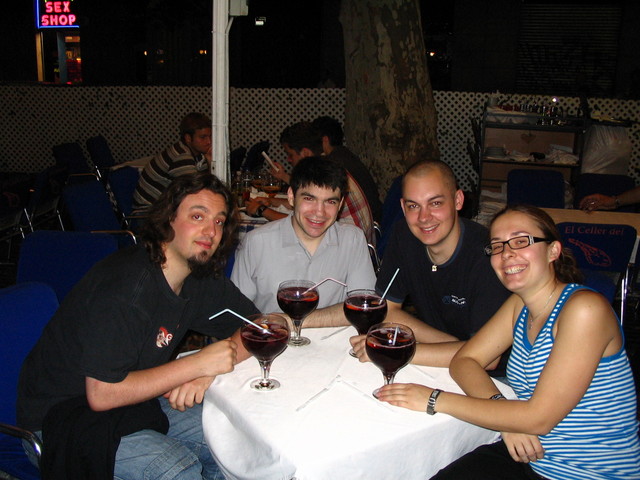
From right to left: Karolína, Jan, Kaleo, me.
The week went on with many visits, and consuming of food which was much more decent than what is available in UK: chorizo, saucisson, paella, tapas and friends. The beach was a quite nice place to be; only you get asked about every 10 mins if you want a fresh beer or a massage. But while you're swimming, nobody's there to annoy you :). Since I'm lazy, I'll just put some pics:

We had to wait for Karolína all the time...

Jan was pretending to swim, but his feet were touching the ground.

Me, resting on the beach.

Kaleo's garden.
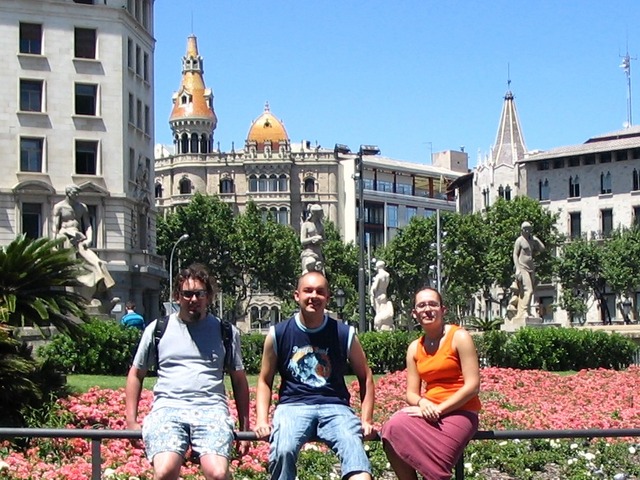
Our heroes on plaça Catalunya.
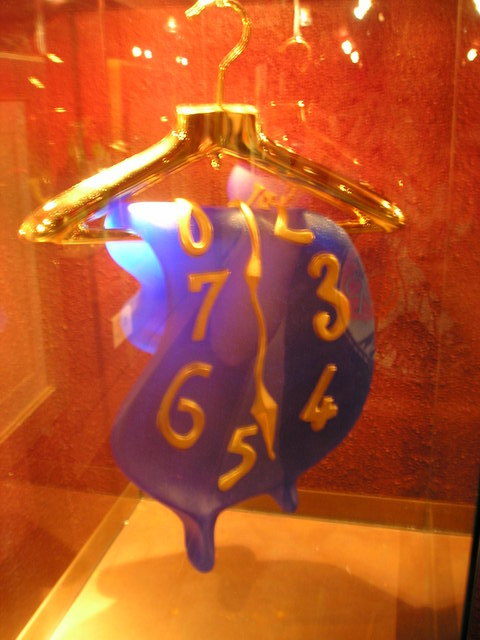
One of the few things I liked in the Dali museum.
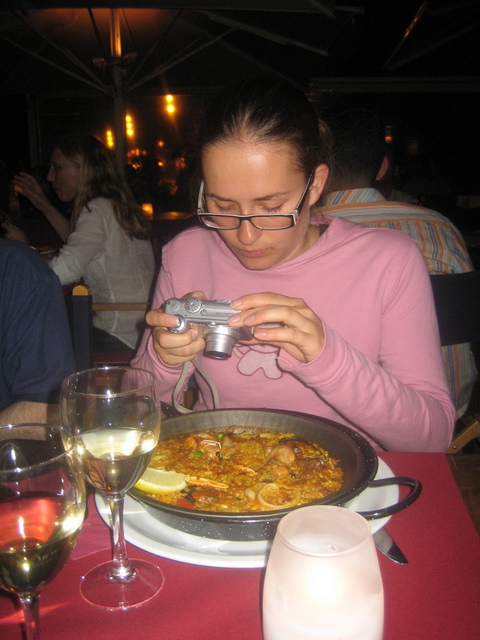
Kája discovers what a shrimp is. Unfortunately, the manual was not provided...

Don't give cameras to children... The Polish guy on the left is Arek, a colleague of Kaleo.

Cool view.

He too can say he was there.

The Beauty and the Beast, Catalan version.

Neuf Un !
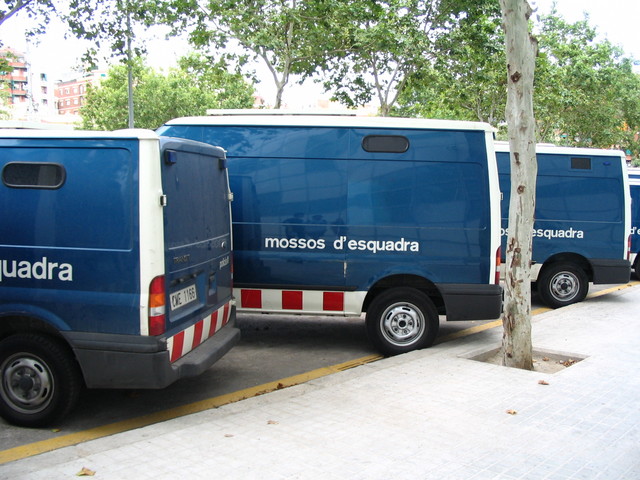
We've been told it's forbidden to take pictures of the cops' cars.

Kaleo's house is being refurbished.
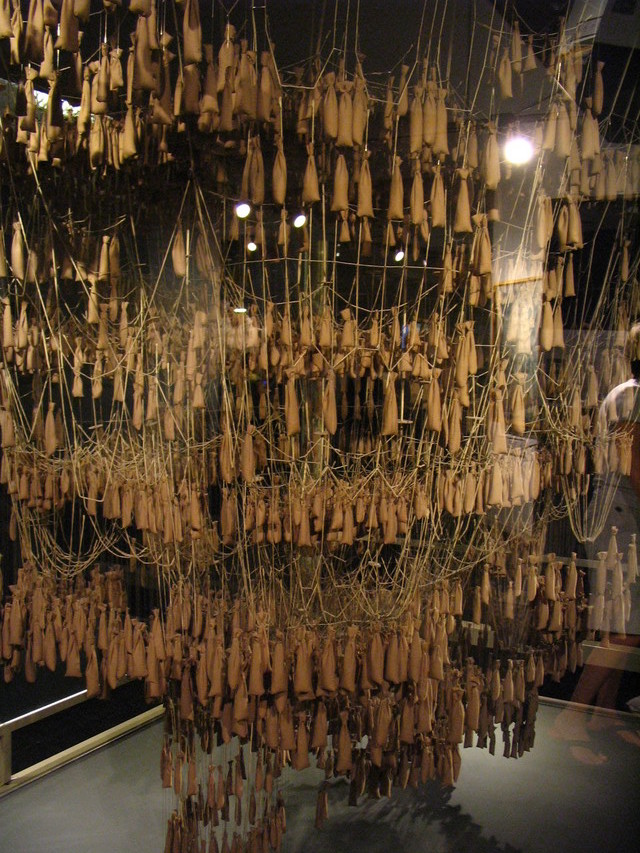
Gaudi knew how to discretize a problem.
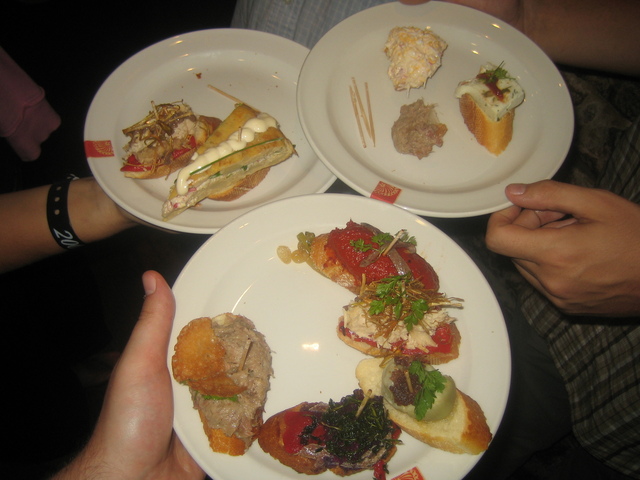
Tapas!

The chocolate museum :)

I'm so cool !

The mayor is a big fan of Dr Zoydberg and had this statue erected.
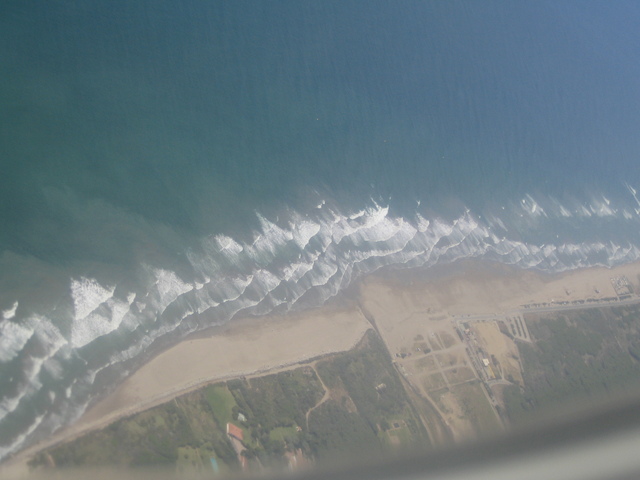
That's all folks! This is a beach near Barcelona, seen from a plane leaving to Scandinavia.
Soon here: an article about the following week which I spent in Norway, and maybe an article about the (wild) life in a Hostel in Barcelona.
In the meantime, Thomash made an article (in French) about my week visiting him in Trondheim.
All the pictures aren't by me, I stole those of Karolína and Jan. You can find everything here. Ask me for the login/pass. ]]>
Unfortunately, this gadget has a serious flaw: it's quite unstable. My guess is that it is still in an early stage of development and I was given an alpha release. I figured out that the instability is caused by the way the high-tech electronics are positioned. I don't have the necessary hardware skills to change the position of the electronics, but I found a simple solution to make it much more stable: simply pour rice in it.

After doing this, I've found it's much more stable. Yet, the solution is not perfect: it's not able to reach the same speed as before the hack, and I suspect it leaks from time to time, I wonder if valgrind can help me here :).
]]>Now, the big problem everybody knows with text messages, compared to, say, emails or proper instant messaging, is that you get charged to send texts. And of course, your text messages are limited in size, so that you have to send (and pay for) several messages to say what you want, unless you are ready to sacrifice the language you are using and end up using only words of up to 3 letters... I don't know the effects this has on the English language, but in French, some teenagers mainly write in that style, and don't know how to write french properly anymore...
Hum, I'm getting off topic here; what I wanted to say is that, yesterday morning, I discovered another big (maybe worse) drawback of this "technology":
wap.MobyMagic.
com/XXXXXXXX
You are
subscribed to
the MobyMagic
content club for
£4.50 per week
until you send
STOP to 84010.
Helpline
084517XXXXX
Sender:
84010
Message center:
+44XXXXXXXXXX
Sent:
17-Mar-2007
11:42:15
That's a nice way to wake up. I was a bit surprised since I never contacted that company. Not *that* surprised though, since I think it's not the first time I have received spam on my mobile phone.
What is new and makes me love technology, is that, upon reception of that message, I discovered that my tesco mobile top-up account actually lost £4.50.
That is what I didn't know about the wonderful text messages techonology:
You can get charged for messages you receive, even unsolicited ones !
In the following 1/2 hour, I received two other text messages from the same origin, telling me how cool their wap site is (I'll have to believe them, since my phone doesn't support wap). Each of these messages cost me about £1...
I have emailed tesco mobile customers service about this, and blocked that number from my phone (well, I think it's blocked, the interface of my phone isn't very explicit on that...). Even though it was a Saturday, I got an answer today (sunday), telling me I wasn't the only one in that case, and that £4.50 was put back on my account (therefore, I still have about £2 gone to MobyMagic...). I've just emailed them back, and I'll see what they do.
I wonder how many people got a similar message, and what percentage just didn't care, not realising they actually lost money. I guess the guys behind that company are already somewhere far away with the money they made... [Note: tesco has recredited £4.50 on my account, but they told me: "Tesco Mobile will be contacting this company to recoup the costs and
enquire why these messages have been sent out without a valid request." This makes me think that company may actually have these £4.50, and if they disappear quickly on a remote island, Tesco will never get that money back from them]
Update: Tesco has credited another £1.50 on my account on Tuesday.
]]>
I think a decision should be made quickly, since the website says:
Meanwhile, demand for this year’s festival has seen tickets sell faster than ever before, camping spaces have nearly all gone, and we are looking into an extension to the Donington Park capacity.]]>
I hope *everybody* will be there :)
]]>
Misc notes:
- When Keith Packard was searching for a generic name for N800-like devices, someone proposed "Personal Bedside Porn Viewer". A nice discussion on how many free hands you need to operate it followed :)
- Metasploit 3.0 (not out yet, still in beta) looks really great, the demo was impressive, these guys just seem to have implemented *everything* in it
- Idiot: "C'est pas Linux ça, c'est Coca Cola" Miguel de Icaza: "Qu'est-ce que c'est Coca-Cola ?"
- I really should try gdb tracepoints
- I really should find some time to hunt memory leaks or do stuff like that to help the OLPC Project. I think it's the most important libre software project since GNU
- Belgian beers really have nothing to do with what you generally can find in England
- I should do some more kernel hacking, Jim Blandy made me want to. I hated when I made that kernel school project and lost *nights* debugging quick'n dirty code with printk()s. Things look much easier with gdb kernel tracepoints (and, well, that project is just sexy)
- I don't like certifications, but the OSSTMM methodology looks really clever; security done the scientific way :)
- Brussels is a really cool town.
- Yet, even in Brussels, you should beware of pickpockets in touristic areas; Toto knows what I'm speaking about...
I'll try to upload some pics one day, but since I was a long time without internet, I am something like 3 or 4 months late with photos uploading...
]]>
Who wanna join ? It can be great fun if we are many of us!
(people who hate metal, please disregard this article).
Update: Slayer confirmed !
Update: Korn too !
Update: and Machine Head too :)
Update: shit,
Would YOU come to Cambridge for that night ? That probably implies sleeping in your sleeping bag on the carpet if you come from far, since I have beds in limited amount (1 bed, 1 sofa). It can be an occasion to do some tourism in Cambridge too.
Update: Well, I've had an impressive number of ...2 responses, one being a "I can't come", so, well... I don't think I'll do anything, unless I get a lot of 'I wanna come' today or tomorrow.
]]>
]]>
For those who didn't know yet, I started today my new job at Autonomy.I have to wake up in the morning, but so far, I'm still alive.
]]>
I'll try to upload some pictures there quickly, but to sum things up: my tour de France of friends and family was really cool, and it's really great to be back in Hull, even if it's not for a long time. I just feel home when I'm in the Sanc :).
]]>
4. Prepare the Wires
We gotta cut and strip the wires to be able to connect them to the socket.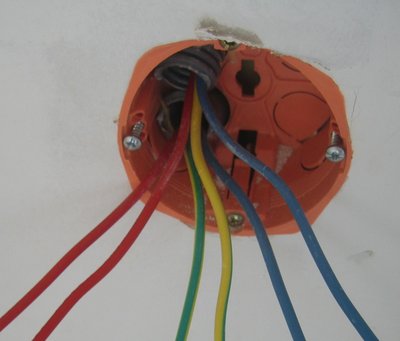
First, we sort the wires by colour, because it's much more fancy. Put the red ones (live, the wires that "pull and push" the current) on the left, the green and yellow striped ones (ground, the "security" wires) in the middle, and the blue ones (neutral, those that "receive" the positive or negative current) on the right. Note that in countries other than France, colours and positions may change.
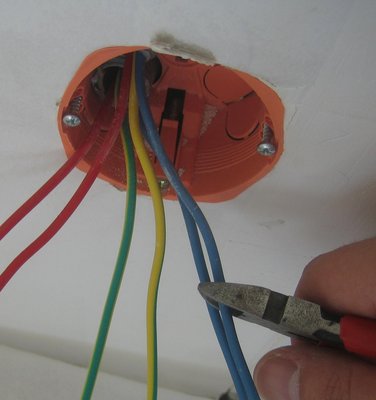
Cut the wires at a "good" length: long enough to manipulate them easily, but short enough so that you can put everything (with the socket) in the orange box eventually. The cables won't suffer, it's like cutting your hair or fingernails. Note however that, to do that, you must be certain that the current is turned off, else YOU may suffer some pain (which can be good to wake you up in the morning, esp. in case of hangover).
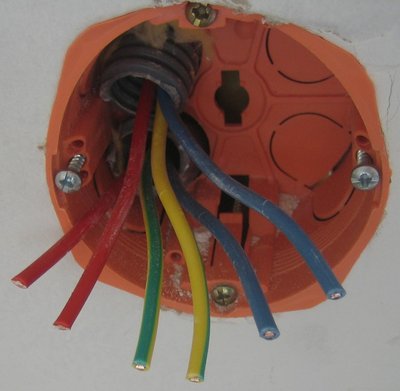
How cute it is with its new haircut !
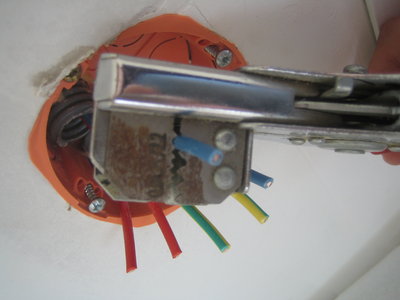
Next, use a wire stripper, you want the wires to get partially naked (much sexier).
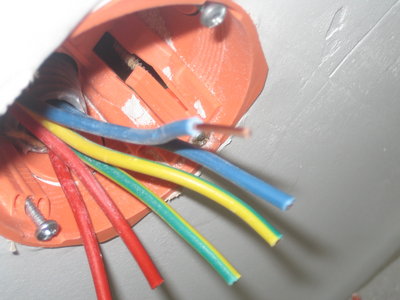
That blue wire is so hot I had to put a blur effect on it, since there may be young people reading this blog.
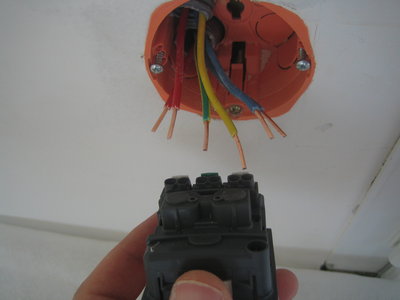
Now, guess what's next ?
5. Connect
What do you think's next ? You must be thinking it's time to connect the wires to the socket using these nose-picking pliers. If we don't do that one day, you'll never have juice in your socket...
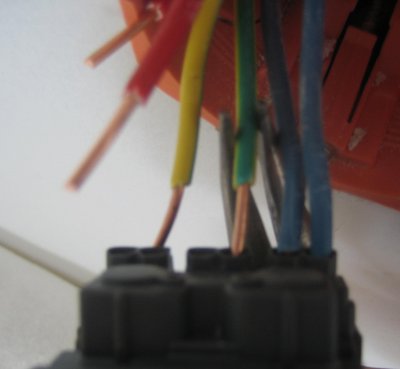
Please scroll down.
5. Connect Fix the Grid
Well, if you were thinking what I think you were thinking, then, you're wrong. You should first fix the grid on the orange box, else, you won't be able to fix the socket, and that wouldn't look very professional, would it ?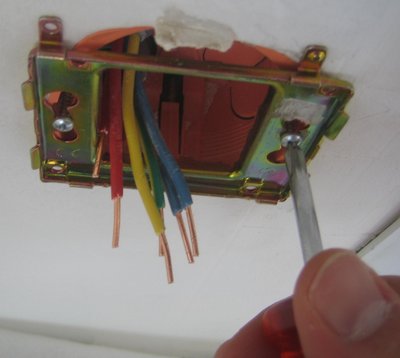
Quite simple, you just have to screw.
6. Connect
Okay, now, the grid is in place, we can connect the socket. Note that we could have instead fixed the socket on the grid, and screw the grid and socket block on the wall later, but I find it easier like this.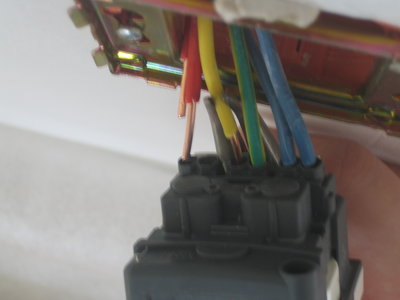
Use the nose-picking pliers to do what they're best at (apart from picking a nose).
As a side note, here is a picture of another (cheaper) kind of sockets, which only confirmed socket installers can install, and believe me, you don't wanna install one of these: you have to prepare longer lenghts for the red and blue wires, which mean it will be a pain to fit everything in the orange box, and you have to screw the wires into the socket, two at a time. You also MUST fix the socket to the grid before fixing the grid, because you physically can't fix the socket to the grid with the wires connected...
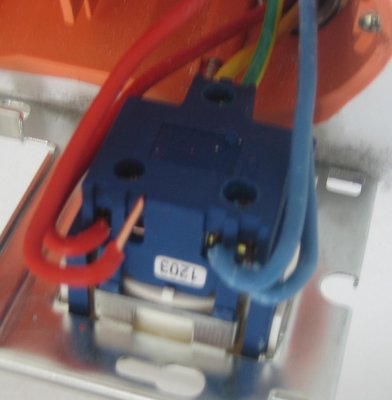
But here, we are lucky, we got one of these high end sockets, which my little sister could connect.
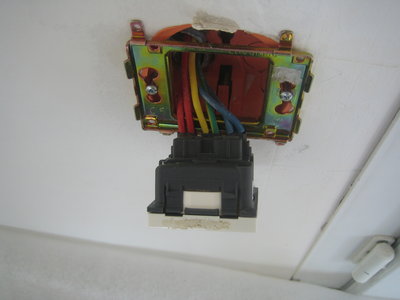
Here is how it looks like when the wires are connected to the socket, before fixing the socket to the grid.
7. Finnish
Good, we're nearing the end !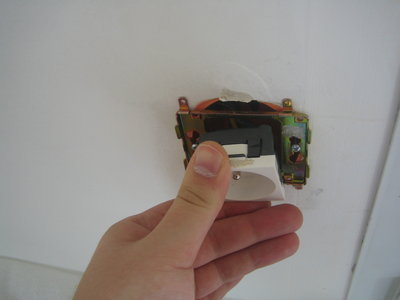
Push the socket in the grid. This is the time when you will discover if you cut the wires too long for them to fit in the box...
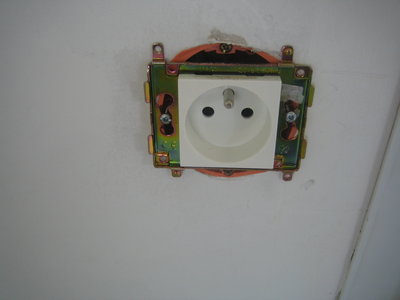
Yeah! It fits !
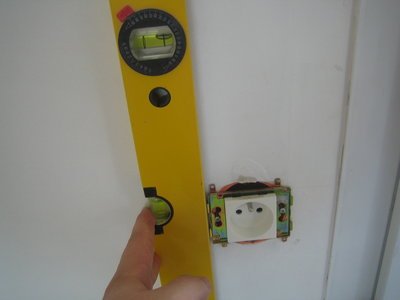
Now, since you want your socket to be beautiful, you want it to be level. Here, it isn't...
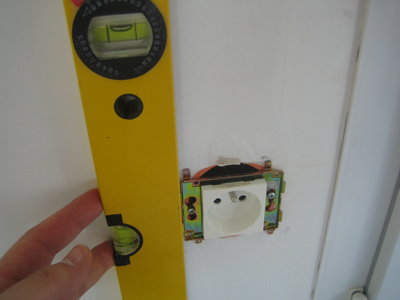
Unscrew a bit the grid, and turn it a bit so that it's level, and screw it again.
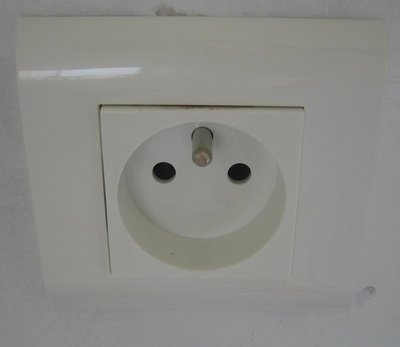
Now, all you have to do is to make your socket put on its nicest dress. Of course, it can be an 80s dress to go to friday night 80s party in the rez, but it doesn't have to.
This is it, now, you know how to install a socket, and you can play that game at home (supervised by an adult). I'm sure you will find that game very funny, especially when you realise that europe's electric power sucks almost as much as in the US, and you eventually end up not using that socket, and lighting candles instead. After all, candles are much more romantic (but don't light candles alone, it's dangerous, ask an adult !)
]]>
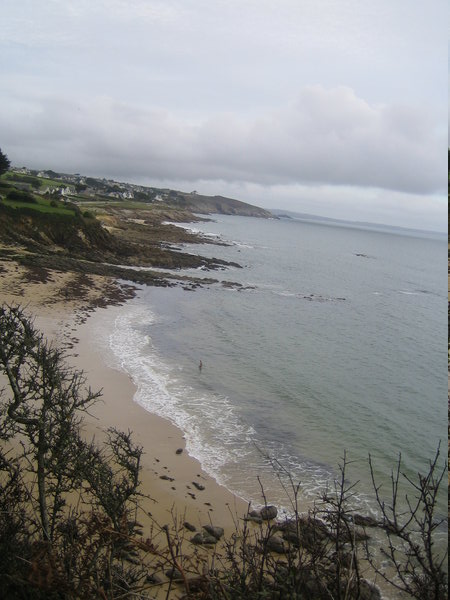
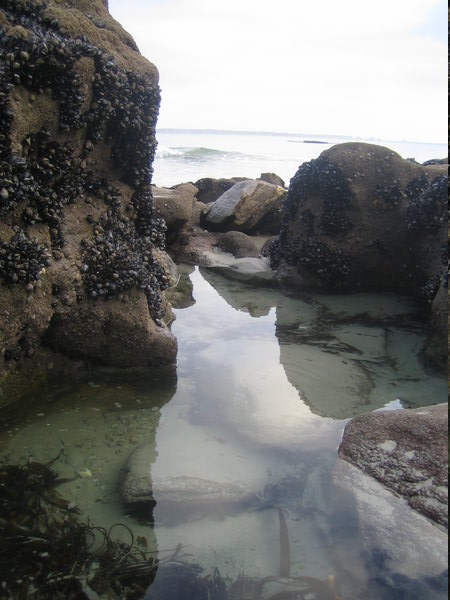



 ]]>
]]>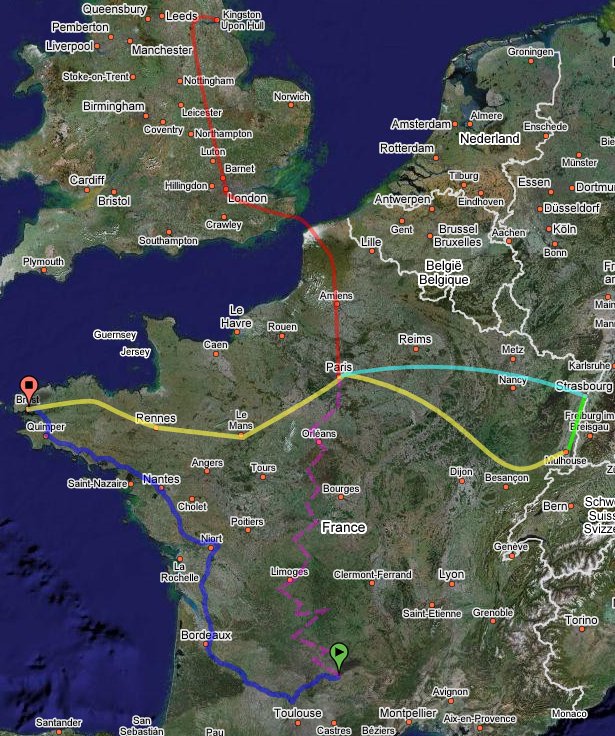 Tomorrow, I start my one month wandering through France and more.
First, I will go with my parents to Brest, at my sister's (10+ hours of car, in blue on the map). I will stay there for a week, and on the 2nd of november, I'll take a train (alone) from Brest to Mulhouse, through Paris (10+ hours of train in yellow, add about 3 hours between when my train arrives from Brest and when the other train departs to Mulhouse). I will stay there at my grandparents for 2 days, I hope I'll be able to see many people from there, before I go to Strasbourg on the 4th (only 1 hour of train, in green) to see more friends. Then, on the 7th or 8th, I'll take another train (4-5 hours, in cyan) to Paris, many friends to meet then again, hope there will be many BRUUTAAALIIIIISTs around.
But this is only the beggining :) On the 10th, I'll take the eurostar to London, and then another train to Hull (about 7 hours including waiting, in red). Then will start a crazy week of pubs and parties, until the 20th when I will go back to Paris (unless I find a job in England starting immediately). From there (unless I start a job in Paris or anywhere else in France), I'll go back to my parents using that sloooooooow train (7 hours, in pink/purple).
Tomorrow, I start my one month wandering through France and more.
First, I will go with my parents to Brest, at my sister's (10+ hours of car, in blue on the map). I will stay there for a week, and on the 2nd of november, I'll take a train (alone) from Brest to Mulhouse, through Paris (10+ hours of train in yellow, add about 3 hours between when my train arrives from Brest and when the other train departs to Mulhouse). I will stay there at my grandparents for 2 days, I hope I'll be able to see many people from there, before I go to Strasbourg on the 4th (only 1 hour of train, in green) to see more friends. Then, on the 7th or 8th, I'll take another train (4-5 hours, in cyan) to Paris, many friends to meet then again, hope there will be many BRUUTAAALIIIIISTs around.
But this is only the beggining :) On the 10th, I'll take the eurostar to London, and then another train to Hull (about 7 hours including waiting, in red). Then will start a crazy week of pubs and parties, until the 20th when I will go back to Paris (unless I find a job in England starting immediately). From there (unless I start a job in Paris or anywhere else in France), I'll go back to my parents using that sloooooooow train (7 hours, in pink/purple).
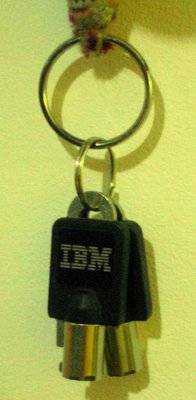 That's my keyring: my computer is my only home these days...
Anywhere I roam Where I lay my head is home]]>
In France, we use type E sockets and plugs. I will explain to you, lucky reader, how to install one (who said I got nothing to do ?), that is, how to transform
this
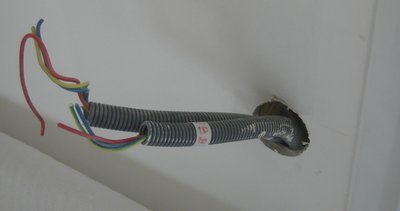 into that
  .
.Since I feel it's a bit long, this will be cut in two (or maybe more) articles.
0. Tools & Hardware
First of all, you need some tools:
Various kinds of pliers and screwdrivers. Notice the curbed pliers in the top: ideal shape to pick your nose with it!
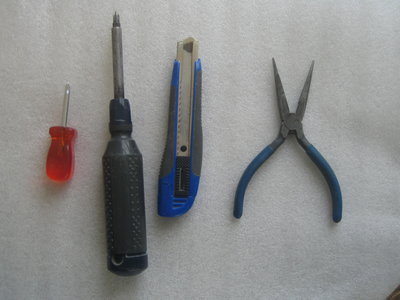
more screwdrivers (you never know, might be useful), a knife (what's the proper word ? anyway, be careful not to cut yourself; preferably, ask an adult to do the parts making use of it), and more pliers (that's the model for people with a long nose).
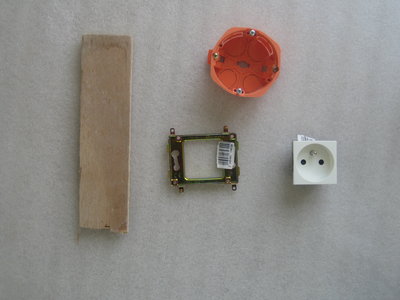
Of course, you're going to need the socket itself, the plastic box to put it in, isolated from the wall, a metal grid to fix the socket to the isolating box, and a piece of wood, which can be useful to threaten the plastic box, in case it refuses to get in the wall (BRUUUUTAAALIIIIIIIIIIST ! [1]).
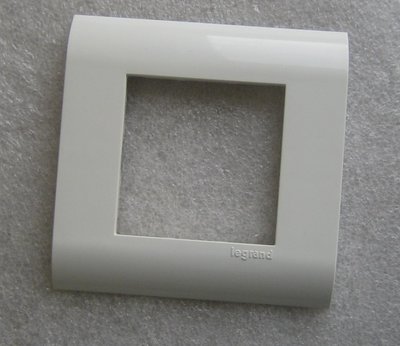
If you want your socket to look beautiful, you're going to put some clothes on it...
1. Check
If you don't want to get an electroshock, you gotta check the map first, to know what socket you're going to install. In our case, it's called "PB7". A very romantic name indeed. Some may think it is called like this because I've watched prison break too much. That's wrong, my dad choosed that name: P is for Prise (the french for socket), B is the series of sockets it is in, which consists in 8 sockets, numbered PB1 to PB8.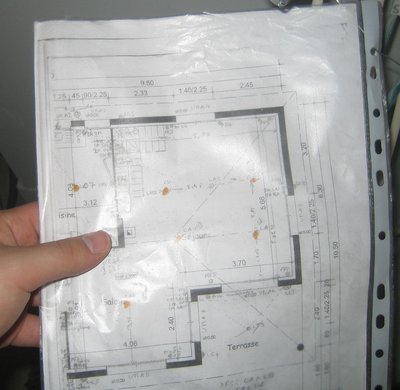
The map
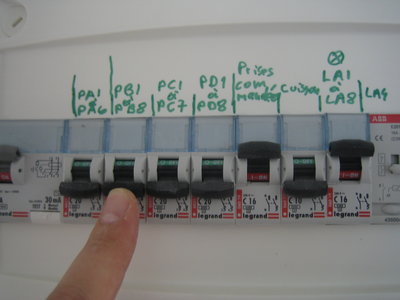
Once you have checked which socket you are going to install, check carefully that the fuse for that socket is deactivated (ask an adult if you're too short to reach the fuse box, or if you can't read).
2. Cut
Now that you're sure to be safe, you can start messing with the wires. Keep an eye on your little sister, though, you don't want her to play with the fuse box and turn on the juice on your wires !You have to cut that grey thing (which probably has a proper name in english, from here on, we'll call that a snake). You should cut it at the right length, so that at the end a small length of it (about a centimetre) will be in the plastic box.

Cutting...
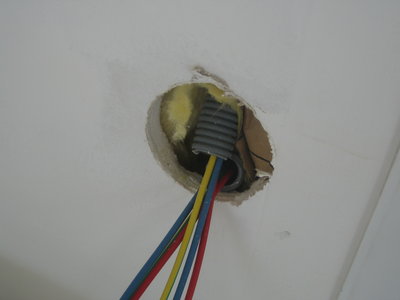
Result.
3. Put the Box
Now, it's time to put that orange plastic box in the wall. Before that, you have to "open" two holes according to the positions of the grey snakes. To know which holes to open, you must have noticed there are 4 screws on the box: two connected to hooks, to fix the box on the wall, and two to fix the grid to the box. The screws linked to the hooks must be oriented vertically.Once you have your holes ok, make the wires go through these.
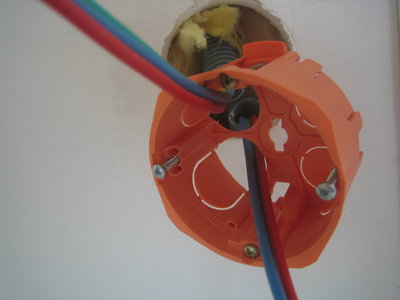
And then, you simply put the box in the hole in the wall... Com'on! Get into it! Bitch! It doesn't fit!
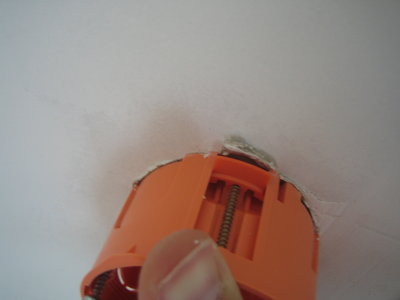
The hole is too narrow :/
Don't worry, there is a BRUUUUTTAAAAALIIIIIIIIST [1] solution to every problem. Remember that piece of wood among our tools ? It's time to use it. Put it on the orange box, and hammer it with your fist (sensitive people -girls- : use a hammer instead), in the direction of the hole. It won't resist long, I promise.
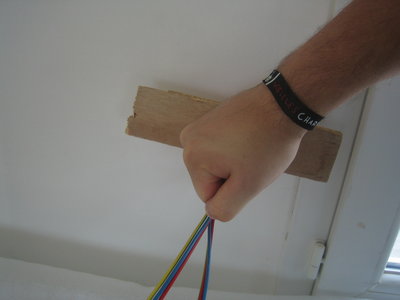
Notice the nice wristband of the operator.
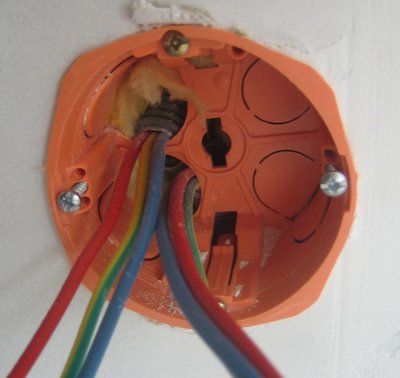
Now, who's the boxx ?
On the picture above, you can see the box is in the wall, but the snakes (they are shy animals) are hidden behind it. For obvious insulation reasons, we want them inside the box. The pliers come handy here.
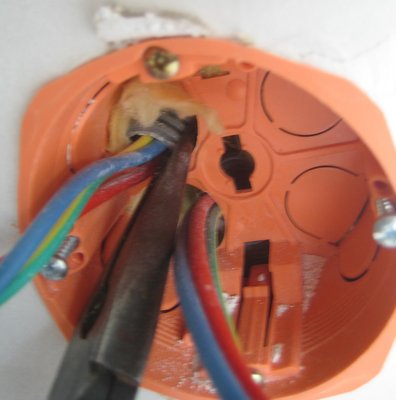
Pull the snakes inside the box with the pliers
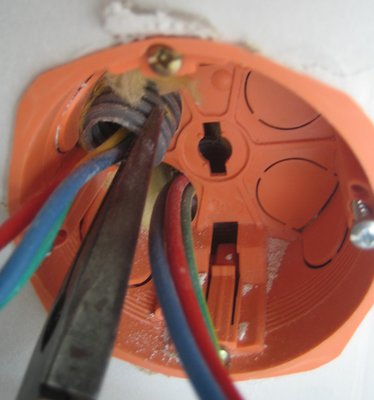
like this
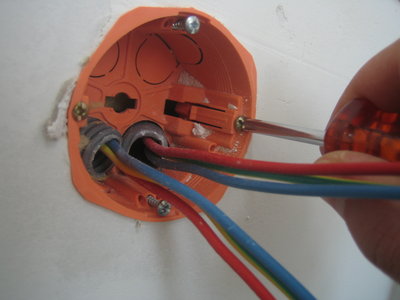
Now, screw the hooks so that the box is tightly fastened to the wall.
This is it for the first part. Now, you're ready to connect the socket and put it in the box, but we'll see that in the next lesson :)
[1]: if you don't understand this, it's because you don't need to ]]>
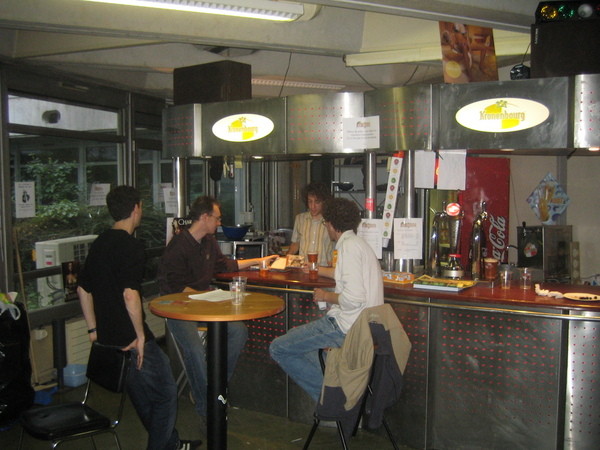 Le bar© et ses piliers (dans l'ancienne salle repro).
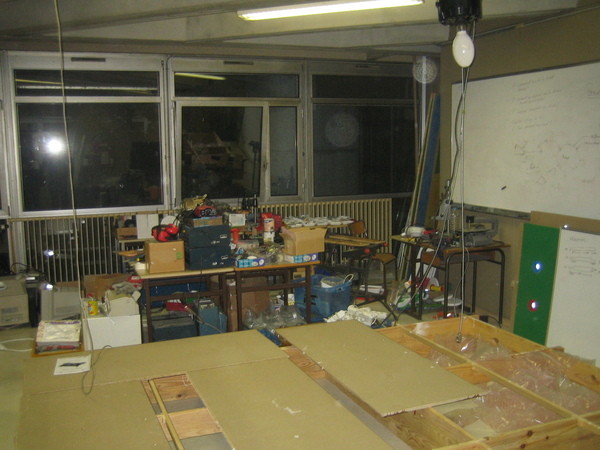 Ils ont prévu de ranger robot bientôt (le club se trouve maintenant en face de l'amphi 2a, c'est tout petit !)
]]>
Ils ont prévu de ranger robot bientôt (le club se trouve maintenant en face de l'amphi 2a, c'est tout petit !)
]]> The door being installed in the house that will be rented (interesting process, isn't it ?)
 The house where my parents will soon live, and where I install sockets.
 My dad and my dog (Bianca) working hard in the house (the more you work, the more you need a break :)
]]>
My dad and my dog (Bianca) working hard in the house (the more you work, the more you need a break :)
]]>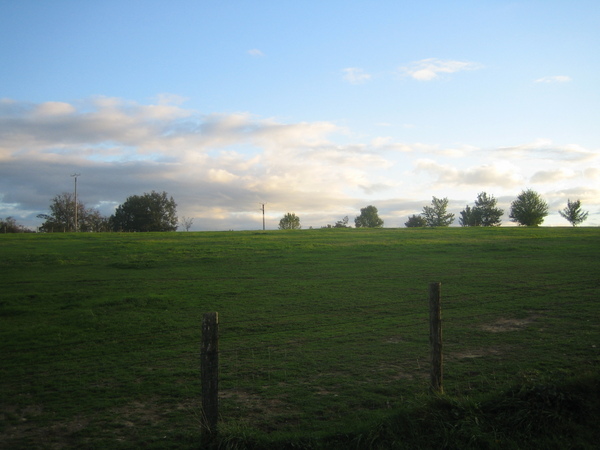 The landscape seen from the back of the house (aka, the kitchen). The view from the front is much nicer, though.
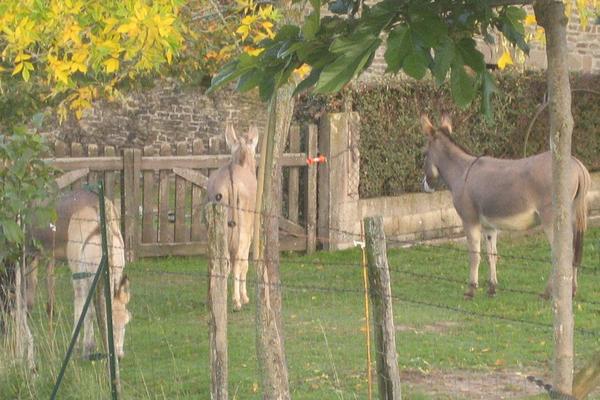 Donkeys 3 metres from the house !
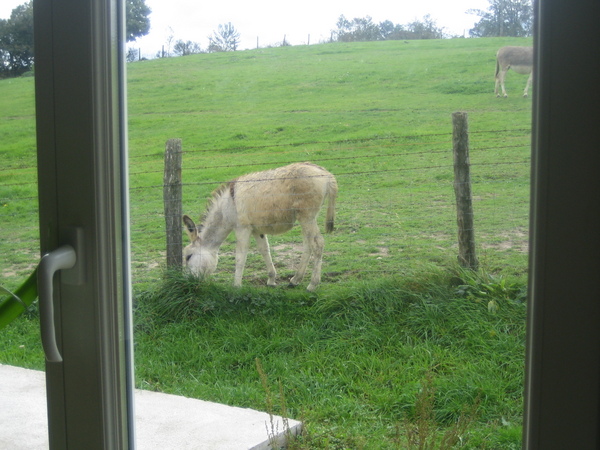 Donkeys again.
]]>
Donkeys again.
]]> ]]>
]]>For you non french readers:
This is it, I brought my MSc thesis to the bindery, and I should submit tomorrow. I have a few days left to party with you guys :). I'm really sad of leaving, I had a really great year in Hull. I really feel like I should find a job in England, if I am not accepted for the PhD to which I have applied.
]]>
NE SORTEZ PAS SEULS !
ÉVITEZ DE VOUS BALADER AVEC DES GRAINES DANS LES POCHES !
 ]]>
]]> Comme l'image le montre, on l'a un peu goûté pour vérifier que c'est bien ce que ça prétend être, et effectivement, ça l'est bien. On s'est donc contenté de juste un peu de pain perdu, cette chose étant plutôt ...inutilisable; mais c'était bon quand même (et disons-le, c'était le dessert après une grosse tortilla, donc on n'a pas vraiment manqué).
]]>
Comme l'image le montre, on l'a un peu goûté pour vérifier que c'est bien ce que ça prétend être, et effectivement, ça l'est bien. On s'est donc contenté de juste un peu de pain perdu, cette chose étant plutôt ...inutilisable; mais c'était bon quand même (et disons-le, c'était le dessert après une grosse tortilla, donc on n'a pas vraiment manqué).
]]>Effectivement, j'ai posté 2 articles en peu de temps depuis. Il y a aussi que je suis passé à wordpress 2, qui est bien plus utilisable que le 1.5.x]]>